
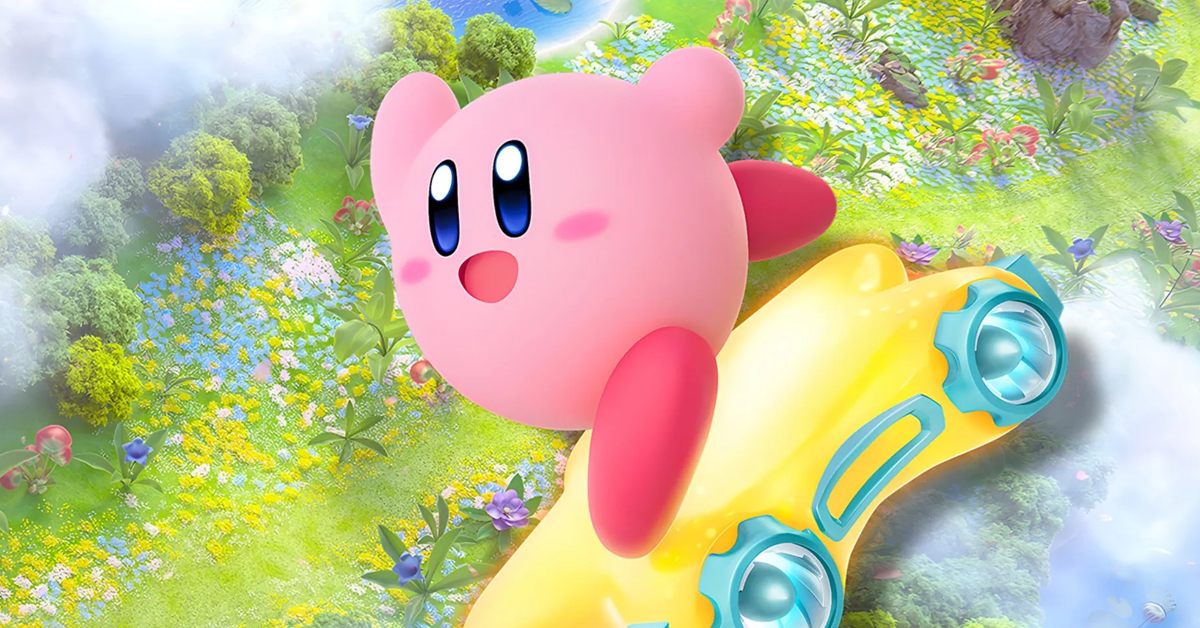
When Nintendo revealed Kirby Air Riders, the knee-jerk reaction was: ‘Oh, it’s just Mario Kart with Kirby.’ But that couldn’t be further from the truth. This game isn’t about karts at all — it’s about wild hover machines that never stop moving, copy abilities that turn Kirby into the item system itself, and a chaotic City Trial-style mode where anything can happen. Calling it a Mario Kart clone misses what makes it unqiue — so let’s dive into why Kirby Air Riders is its own kind of racing chaos.
The Mario Kart Expectation
It’s easy to see why people immediately compared Kirby Air Riders to Mario Kart. Both are bright, colorful Nintendo racers, filled with cheerful characters, chaotic energy, and plenty of shortcuts and surprises. If you only watched the reveal trailer for a few seconds, it almost looks like Kirby just hopped into Nintendo’s most popular kart series.
But once you take a closer look, the similarities are only surface-level. Mario Kart has defined what a Nintendo racing game looks like for decades—boost pads, drifting, item boxes, and the familiar balance of chaos and skill. It’s a formula that’s been polished over eight generations of consoles, so whenever Nintendo puts another character in a vehicle, the assumption is that it’ll follow the same rules.
That expectation sets up Kirby Air Riders perfectly, because this game is built on a completely different foundation. Where Mario Kart focuses on precision driving and timed items, Air Riders is about momentum, machine control, and abilities tied directly to the characters themselves. Instead of just slotting Kirby into the Mario Kart mold, Sakurai and his team asked a different question: what would a racing game look like if it was designed entirely around Kirby’s world and mechanics?
The Core Difference: Machines That Don’t Stop
Unlike Mario Kart, where you’re constantly holding down the accelerator, Kirby Air Riders throws that idea out the window. Your machine never stops moving. The game is built around the idea that forward momentum is constant, which completely changes how you think about racing. Instead of worrying about speed control, your attention shifts to steering, positioning, and finding ways to turn that unstoppable motion into an advantage.
The most important mechanic here is the Boost Charge. When you slam your machine down onto the track after a jump, Kirby stores that impact as energy. Release it, and you’ll launch forward with a powerful burst of speed. It’s a rhythm that mixes control with chaos—you’re not just driving; you’re bouncing, boosting, and chaining momentum together. Suddenly, the race isn’t about clean lines around corners, but about mastering when and where to hit the ground for maximum payoff.
Then there’s drifting, which takes on a new meaning in Air Riders. Tilting into corners isn’t just about style or shaving seconds off a lap; it’s a crucial part of managing your machine’s energy. The system rewards you for leaning into the chaos, making every bend in the road a chance to stockpile momentum for your next boost. It’s less like driving a car, and more like wrestling with a machine that’s alive and unpredictable.
And that’s the heart of the difference. Kirby Air Riders isn’t about vehicles that you control in a traditional sense—it’s about learning the quirks of these strange, floating machines and turning their wild, unrelenting motion into victory.
Kirby’s Powers Change Everything
One of the biggest differences between Kirby Air Riders and a traditional kart racer is how power-ups work. In Mario Kart, you drive through an item box and hope for the best—maybe you get a shell, maybe a banana, maybe a star. It’s chaotic, but it’s also temporary. Once you use the item, you’re back to being just another racer.
In Kirby Air Riders, Kirby himself is the power-up system. Thanks to his signature Copy Abilities, swallowing an enemy doesn’t just give you a quick attack—it can completely change the way you play. Suddenly you might have a Sword to slash opponents, a Bomb to lob across the track, or Spark to zap anyone who dares get too close. These abilities aren’t just little extras; they become central to your racing strategy, shaping how you approach turns, opponents, and even the terrain itself.
What makes it even more interesting is that not every rider plays the same way. Kirby leans into Copy Abilities, but characters like Meta Knight and King Dedede rely on unique Specials instead. Meta Knight might dart across the track with precise strikes, while Dedede can use brute force to throw his weight around. This means your choice of racer isn’t just cosmetic—it decides your entire toolkit for the race ahead.
It’s this system that really flips the “Mario Kart clone” label on its head. Items in Mario Kart are external and random; in Air Riders, your abilities are internal and tied directly to your character’s identity. That simple shift makes every race feel more personal, more strategic, and more Kirby.
Skyah & City Trial’s Successor
If there’s one feature that really cements Kirby Air Riders as more than a Mario Kart look-alike, it’s the return of a City Trial-style mode. Fans of the original Kirby Air Ride on GameCube will remember how much life that mode gave the game, and here it’s reimagined on a much grander scale with the floating island of Skyah.
The mode unfolds in two distinct phases. First, players are dropped onto Skyah itself—a sprawling, open environment where you collect power-ups, snag machine upgrades, and even battle wandering bosses like Kracko or Dyna Blade. Unlike traditional racing, you’re not just speeding to the next checkpoint—you’re exploring, scavenging, and deciding how to prepare for whatever lies ahead. With only a few minutes on the clock, every decision matters. Do you chase upgrades? Do you pick fights? Or do you play it safe and stockpile resources?
Once time runs out, the second phase begins: the Stadium event. This is where everything you collected in Skyah suddenly matters, because the Stadium could throw you into anything from a straight-up race, to a demolition derby, to a completely unpredictable battle type. The twist is that you don’t know which one you’re getting until it starts. That uncertainty makes every run feel fresh, and it forces players to adapt their strategy on the fly.
This unpredictability is exactly what sets Skyah apart from linear kart racing. Instead of memorizing tracks and rehearsing item usage, you’re thrown into a constantly changing playground where improvisation and quick thinking are the key to victory. It’s chaotic, yes—but it’s also deeply replayable. No two sessions on Skyah feel the same, and that’s why City Trial became legendary in the first place. Kirby Air Riders doesn’t just bring it back—it evolves it.
Sakurai’s vision
Behind all the wild mechanics and chaotic racing is Masahiro Sakurai, the creator best known for shaping both Kirby and Super Smash Bros.. When Kirby Air Riders was revealed, he explained that this wasn’t just a random spinoff—it came from a direct request from Nintendo leadership. Shinya Takahashi and Satoshi Mitsuhara specifically approached him about reviving the idea, even while he was still tied up with Smash Bros. Ultimate DLC. For Sakurai, the challenge was clear: if he was going to make a new Kirby racing game, it had to feel fresh and unique, not just another kart racer with a pink mascot.
That philosophy is visible in every part of the design. Instead of copying the tried-and-true Mario Kart template, Sakurai built a system where momentum is constant, machines can be destroyed, and power-ups are tied to Kirby’s identity. It’s the same creative mindset he’s brought to Smash Bros.—take a familiar genre, then bend and stretch it until it feels unlike anything else on the market. In Air Riders, that means a racing game where the chaos isn’t random—it’s engineered to push players into new strategies every time they play.
What makes Sakurai’s vision so striking is that it blends accessibility with depth. On the surface, Kirby Air Riders looks approachable: simple controls, bright colors, a fun party vibe. But dig deeper, and you find layers of strategy—choosing machines, mastering Boost Charges, deciding how to prepare in Skyah—that make it just as competitive as it is chaotic. That balance is exactly what Sakurai is known for: games that anyone can pick up, but that experts can sink hundreds of hours into mastering.
In the end, Kirby Air Riders isn’t just a new racing game—it’s Sakurai once again experimenting with genre, trying to create something only he could have imagined. It’s not Kirby trying to be Mario Kart; it’s Kirby carving out a racing identity all his own.
Conclusion
So in the end, calling Kirby Air Riders a Mario Kart clone really misses the point. Sure, both games are colorful Nintendo racers, but that’s where the similarities stop. This is a game built on constant momentum, unpredictable machines, and Kirby’s powers transforming the entire racing formula. Add in Skyah and the chaos of Stadium battles, and you’ve got something that feels more like a wild experiment than a safe spinoff.
That’s the magic of Sakurai’s vision—he’s not just giving Kirby a kart, he’s reimagining what a Nintendo racer can be. And whether you’re here for the nostalgia of City Trial or just curious about a fresh take on the racing genre, Kirby Air Riders looks like it has the potential to stand shoulder-to-shoulder with Nintendo’s biggest franchises.
If you’re excited to see more breakdowns of the game—like deep dives into Skyah, Stadium strategies, or which machines and abilities are the best combos—make sure to hit like, subscribe, and ring the bell so you don’t miss the next video. And I want to hear from you: do you think Kirby Air Riders can carve out its own place next to Mario Kart, or will people always see it as a clone? Drop your thoughts in the comments below.
Leave a Reply