
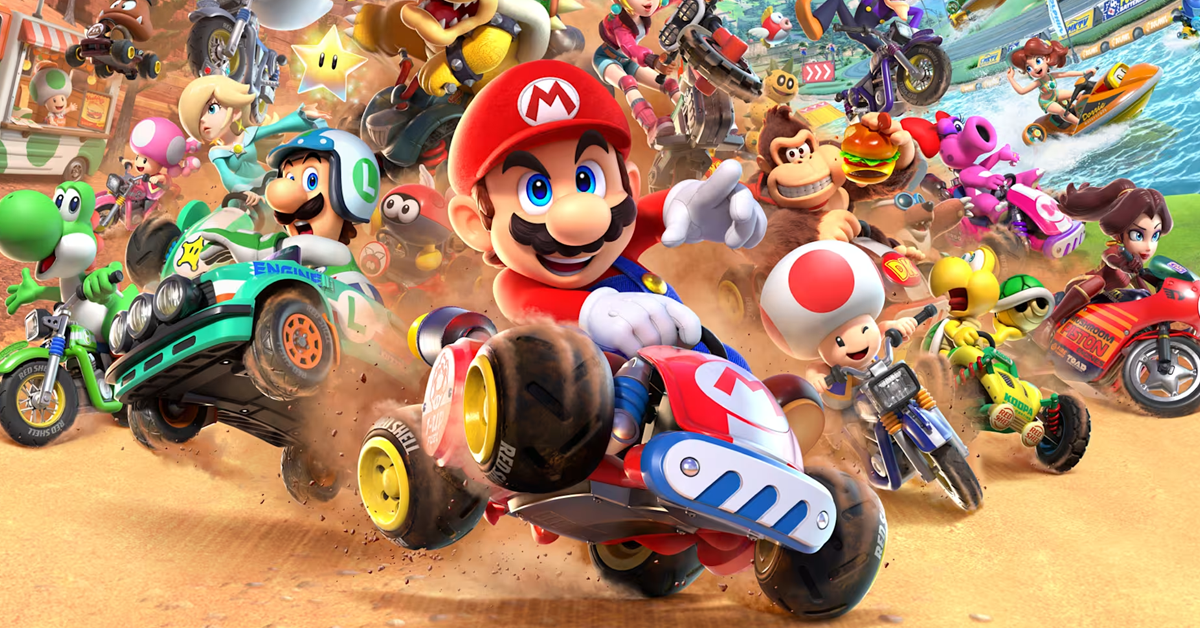
Mario Kart World had the hardest job in gaming last year. It had to follow Mario Kart 8 Deluxe, the best-selling game in Switch history, and it had to do it as a launch title, with all the rushed, unfinished energy that usually comes with that territory. A year on, with a stack of free updates behind it, that’s no longer the full story. This is where the game actually stands now, and why it might be worth a second look.
THE LUKEWARM LAUNCH
Let’s not pretend the reception was rocky across the board, because it wasn’t. Critics were largely positive. The game sits at 86 on Metacritic, generally favourable, with the overwhelming majority of reviews landing positive. The Guardian called it a synthesis of different philosophies of fun.
But critics and players don’t always agree. Go anywhere Mario Kart players actually gather, and you’ll find a much more mixed picture. The word that comes up again and again, from hundreds of separate voices, is “potential.” Not “bad.” Not “broken.” Potential. As in, the ingredients were all there, but the dish came out undercooked.
I felt some of that myself. In my own launch review, I gave the game 8.5 out of 10, and I stand by that score, but I flagged real gaps. Free roam felt sparse. There was no way to select your own music. The open world looked gorgeous, but there wasn’t always much to do.
Fans went further. The most common complaints were about online: no option for straightforward three-lap races, Knockout Tour limited to a handful of pre-set routes, and long, empty “intermission” stretches connecting the real tracks. One popular thread summed up the whole launch as a game built on half-baked ideas within a genuinely great foundation. Great driving mechanics, gorgeous courses, a soundtrack that everyone agreed was one of the best in series history, wrapped around systems that felt like they’d shipped a few months early.
So that was the story at launch: a good game, arguably a great one mechanically, held back by missing options and an underused world. Critics generally play a game across a fixed review window, form an impression of the systems and the moment-to-moment driving, and file. Players live with a game for months, which means the things that don’t bother you in six hours start to grate over sixty. Missing options, thin free roam rewards, and a lack of a straightforward three-lap online mode are exactly the kind of issues that don’t show up in a review score but absolutely show up in whether someone keeps playing in month two.
The question worth asking now is what’s actually changed since then.
A YEAR OF FIXES
Nintendo didn’t respond with a single big relaunch moment. Instead, it’s been a steady drip of updates, several of which go directly at the complaints players were making from day one.
The clearest example is the Knockout Tour itself. At launch there were eight rallies to choose from. Version 1.7, released at the end of June this year, added two more: Drill Rally and Boomerang Rally, each threading together a different chain of courses across the map. That takes the total to ten, and Nintendo has said more are coming. It’s a direct answer to one of the loudest fan complaints, that the Knockout Tour recycled the same handful of routes too often.
Before that, in January, version 1.5.0 added team races to the Knockout Tour. Instead of one winner and 23 also-rans, you can now race in teams of two, three or four, with points awarded by finishing position and the team total deciding the winner. It’s a clever fix for a mode that, as fun as it was, left most of the lobby with nothing to show for a ten-minute race.
Battle mode picked up Bob-omb Blast in March, a returning mode from Double Dash and Mario Kart 8 Deluxe, where Bob-ombs are your only weapon, with up to ten held at once and throw distance tied to how long you hold the button. It’s not a huge headline, but it’s the kind of content that quietly makes the mode feel less thin than it did at launch.
Alongside all of this, Nintendo has been constantly chipping away at the balance. Bullet Bill became faster and easier to control on specific courses, and its lateral movement was widened, making it less of a straight-line-only tool. The boomerang item, which some players felt was overpowered early on, had its range and throw count reduced. Item probabilities have been retuned more than once, and the invincibility window after a crash now scales with a character’s weight, so getting sent flying doesn’t feel as punishing back to back. None of these are the kind of changes you’d put in a trailer, but taken together they add up to a much more considered version of the game than what shipped in June 2025.
And then there’s the stuff players specifically asked for. Custom item rules arrived in December, letting you set exactly which items appear in a race. Music volume got its own slider, addressing one of the most repeated complaints in early reviews, mine included, and the pause menu now shows you the name of whatever track is playing, so you can finally put a name to the songs everyone was raving about at launch. Free roam got a quality of life pass too: the map now tracks which P Switches and Peach Medallions you’ve already found, UFOs got easier to encounter and you can now transform into whatever character gets pulled into one, and even the acceleration and gliding stats for weaker characters and vehicles have been buffed twice.
THE UNGLAMOROUS WORK
What doesn’t show up in patch note headlines is arguably just as important. Nearly every update since launch has carried a long tail of course-specific fixes: players slipping through walls on Dry Bones Burnout, getting stuck on trees on DK Pass, falling through the floor on Rainbow Road when hit by a shell. The day-one patch in June 2025 alone fixed mid-race crashes and expanded the starting character roster. The July update rebalanced the item probability system so that first place isn’t guaranteed a defensive item every single time, more in line with how older entries in the series worked. September brought spectator improvements and shortened the dead time between finishing a race and watching the rest of the lobby.
None of that is exciting on its own. But it’s evidence of a live-service mentality applied to a game that a lot of people wrote off as a one-and-done launch title. Whatever you think of the pace, Nintendo has not stopped touching this game, and the most recent update landed at the end of June this year, a full year after launch.
WHAT’S STILL MISSING
To be fair to the people still holding out, not everything has been addressed. There’s still no dedicated online mode for straightforward three-lap racing outside of time trials, which was probably the single most requested fix from day one. And the core tension fans debated at launch, whether the open world’s connecting roads are a meaningful evolution or just padding between the real tracks, hasn’t fundamentally changed, even if there’s now more to do while you’re driving them.
So this isn’t a story about Nintendo fixing everything. It’s a story about a launch game steadily turning into the platform I described in my original review as having the potential to be.
SHOULD YOU COME BACK
If you played Mario Kart World in its first month and bounced off it, a certain amount has changed. Knockout Tour, the mode almost everyone agreed was the best new idea in the game, now has more routes and a team format that fixes its biggest structural problem. Battle mode has more to it. The items are better balanced. You can actually hear the soundtrack at a volume you choose. And free roam, while still not as dense as some would like, is a lot less directionless than it was.
A year of free, steady updates has closed a lot of the gap between what Mario Kart World was and what people wanted it to be. What’s notable is that Nintendo has done this entirely through free updates rather than paid DLC, which is a different model from how Mario Kart 8 Deluxe eventually reached its full, sprawling form through the Booster Course Pass. Whether that continues or we eventually see a paid expansion, as 8 Deluxe did, is worth watching over the next few Directs. For now, everything covered in this video costs nothing beyond the game itself.
If your last memory of Mario Kart World is from launch week, that memory is genuinely out of date. The core driving, which almost nobody disputed was excellent even at launch, is now wrapped in a package with more modes, better balance, and a longer list of small conveniences that make a game pleasant to sit with for hours at a time. It’s not a different game. It’s the same game, finally allowed to catch up to what it was always capable of being.
Leave a Reply