
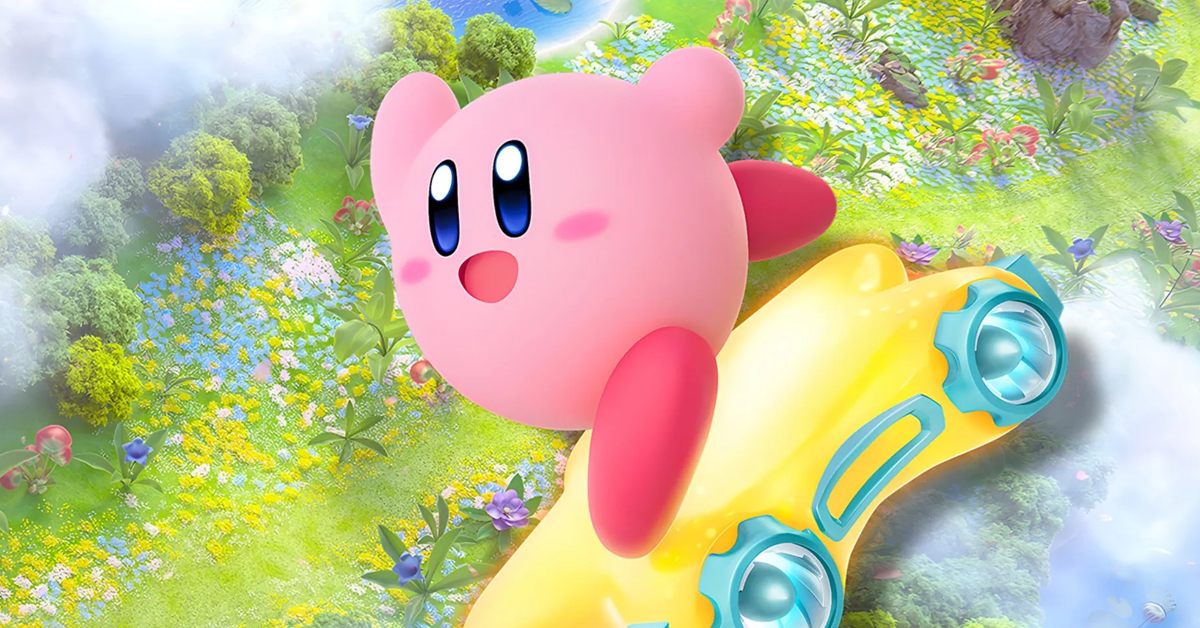
When Nintendo first announced Kirby Air Riders, it felt like the perfect comeback story — a modern revival of one of the GameCube’s most underrated cult classics, Kirby Air Ride. The promise of high-speed, pink puffball chaos on the Switch 2 had fans, including me, buzzing. Early previews painted a picture of a bold experiment — part racer, part arena battler — and it looked like Nintendo was once again pushing the boundaries of what a Kirby game could be. But after spending time with the recent Global Test Ride demo, my excitement turned into hesitation. Kirby Air Riders might just be Nintendo’s most polarising game in years — and not necessarily for the right reasons.
At its core, Kirby Air Riders tries to blend two very different worlds: the pure, pick-up-and-play fun of a Kirby platformer with the competitive, physics-driven chaos of a high-speed racer. It’s built around the idea of freedom — soaring across open tracks, gliding through the sky, and battling for boosts rather than just following a finish line. There’s the classic racing mode, sure, but also sprawling arenas where you collect power-ups, fight enemies, and prepare for a finale event — much like City Trial from the GameCube original. On paper, it sounds like a dream sequel: colourful, creative, and bursting with Nintendo charm. But even early previews hinted that it might be too ambitious for its own good, with IGN comparing it to Super Smash Bros. in its unpredictability and Gamereactor calling it “quite possibly the most polarising game of the year.”
There’s no denying that Kirby Air Riders nails its presentation. Visually, it’s one of the most vibrant and polished games on the Switch 2 so far — bursting with colour, personality, and that signature Nintendo smoothness. The sense of speed is satisfying when everything clicks, and there’s a clear effort to make every ride feel unique, from the nimble Warp Star to the bulkier, battle-focused machines. The controls are simple but expressive, capturing that approachable charm Kirby games are known for. And when you’re gliding through a sunny track with friends online, pulling off last-second boosts or colliding in midair, you can see flashes of brilliance — that classic Nintendo “fun-first” energy that makes their best experiments so memorable. In those moments, Kirby Air Riders feels like it could’ve been something really special.
Once you spend a few hours with Kirby Air Riders, the cracks begin to show. Beneath all the charm and colour, the actual racing feels strangely lifeless. The tracks are beautiful to look at, but they rarely feel engaging to drive through — wide, empty, and lacking the kind of clever design or challenge that keeps you on the edge of your seat. There’s very little sense of progression or danger, and after a few races, it starts to feel repetitive. You boost, you glide, you bump into a few obstacles, and that’s about it. The AI opponents don’t seem to push back much either, and the result is a game that feels oddly slow and passive — not exactly what you want from something calling itself a “high-speed” racer.
Then there’s the combat layer, which seems designed to add depth but instead ends up creating confusion. Power-ups and attacks are flashy, but they often interrupt the flow of a race rather than enhance it. Instead of feeling like a thrilling mix of speed and chaos — like Mario Kart 8 at its best — the action feels disjointed, like two competing ideas fighting for space in the same game. And when you move into the non-racing modes, that identity crisis becomes even more obvious.
The exploration-based arena mode, which clearly takes cues from City Trial, should’ve been a nostalgic highlight — a return to the free-form experimentation that fans loved in the GameCube original. But here, it feels undercooked. The arenas are too large and empty, objectives are poorly explained, and the structure lacks the sense of buildup that made City Trial’s finale events so satisfying. Instead of feeling like you’re preparing for an epic showdown, you spend most of your time aimlessly collecting items without much payoff. It’s confusing, directionless, and, worst of all, dull.
What’s most frustrating is that you can see what Nintendo was aiming for — a game that breaks the mould, that fuses competition and creativity in the way only they can. But somewhere along the way, the execution faltered. The pacing feels off, the excitement doesn’t last, and the result is an experience that’s more exhausting than exhilarating. Kirby Air Riders wants to be both a racer and a sandbox — but in trying to do both, it doesn’t fully succeed at either.
Stepping back, Kirby Air Riders feels like a fascinating snapshot of where Nintendo is right now — creatively restless, unafraid to experiment, but maybe a little unsure of how far to push its ideas. The Switch 2 era has brought a wave of bold, hybrid concepts: games that try to fuse genres, rethink controls, and deliver something players haven’t quite seen before. In that sense, Air Riders fits perfectly into Nintendo’s current mindset — it’s ambitious, colourful, and eager to surprise. But there’s a difference between ambition and coherence, and this game seems to have lost that balance. Like Star Fox Zero before it, or even Wii Music years ago, it’s one of those projects that clearly started with an inspired idea but got tangled in its own complexity.
It’s hard not to admire the intent behind it. You can feel the team reaching for something fresh — a racing game that encourages exploration, creativity, and discovery, not just speed. In an industry that’s often afraid to take risks, that kind of design philosophy should be celebrated. But innovation only works when the fundamentals still feel good, and that’s where Kirby Air Riders struggles. The gameplay doesn’t hold together tightly enough to justify its big ideas, and the result is something that’s impressive in theory but frustrating in practice.
And that’s the gamble for Nintendo right now. The company has built its legacy on reinvention — from Breath of the Wild to Mario Odyssey, it’s proven that radical ideas can redefine entire genres. But Air Riders reminds us that not every experiment will strike gold. Sometimes, being bold means accepting that a few rides will crash before one really takes off. It’s an admirable risk, but also a reminder that even Nintendo’s magic has its limits.
I really wanted to love Kirby Air Riders. It has the personality, the polish, and the potential to be something genuinely special — but after playing the demo, it’s hard not to feel let down. The charm is there, but the gameplay just doesn’t hook in the way Nintendo’s best experiments usually do. It’s a game caught between two ideas, and as a result, it never fully commits to either. For some players, that blend of chaos and creativity might be enough; for me, it’s a pass. Maybe the full release will find its footing, but right now, Kirby Air Riders feels more like a proof of concept than a finished ride. And that’s a shame — because in a world where Nintendo is known for turning wild ideas into magic, this one just doesn’t take off.
Leave a Reply