
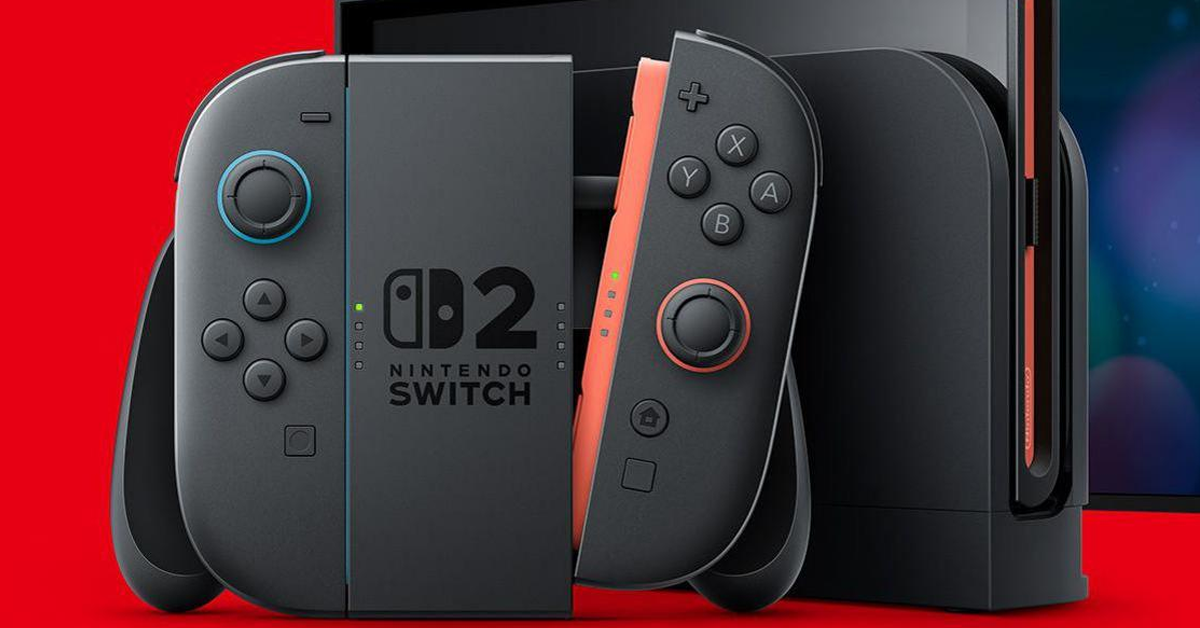
Switch 2 came out swinging in 2025 — huge launch, loads of buzz, and that classic “Nintendo’s done it again” energy. But Christmas is the real test for any console. Not the day-one fans… the mainstream gift-buyers. And that’s where the story gets interesting: Switch 2’s sales momentum reportedly slowed over the November–December holiday window, and the comparisons to the original Switch’s first Christmas aren’t flattering. So what does a softer Christmas actually mean? Is it an early warning sign… or just the market telling Nintendo, “Cool console — now show me the reason to buy it”?
The Headline Numbers: down in the West, steadier in Japan
Let’s ground this in the reported data (and what that data actually compares).
United States: down ~35% vs Switch 1’s launch-year holiday window
The Game Business reports Switch 2 sales in the US across November–December 2025 were down around 35% compared with the same period for Switch 1 in 2017.
UK: down 16% over the late-year stretch, but overall year still up
In the UK, Switch 2 sales over the last eight weeks of 2025 were 16% lower than Switch 1’s last eight weeks of 2017 (NielsenIQ data). But here’s the nuance: when you include Switch 1 hardware sales too, Nintendo’s total hardware sold in the UK over Nov–Dec 2025 was reportedly up 7% versus the same period in 2017 — and full-year Switch 2 UK sales were up 6% versus Switch 1’s first year.
France: the most alarming European datapoint
France was called out as the biggest disappointment: Switch 2 sales in France in 2025 were reportedly “over 30%” lower than Switch 1’s first year — striking because France is usually one of Nintendo’s strongest European markets.
Japan: slightly down in the holiday stretch, but up across the year
Japan is the “least bad” part of this story. For the last nine weeks of 2025, Switch 2 sold 1.32 million units in Japan, which is down ~5.5% from Switch 1’s 1.39 million over the same period in 2017 (Famitsu data). But across the full year, Switch 2 sales in Japan were reportedly up 11% vs Switch 1’s launch year — helped by a cheaper Japan-only SKU and a lineup that better fit local tastes (Kirby Air Riders is specifically cited).
Switch 2 is not “failing”
This is important: “Christmas slowed” isn’t the same thing as “Switch 2 is in trouble.”
VGC notes the slowdown comes after a record-breaking launch: 3.5+ million units in four days and reportedly over 10 million by September — meaning the system is still comfortably outselling its predecessor overall.
So the smarter read is: this isn’t a collapse. It’s the first sign that Switch 2 is moving from early adopter hype into the tougher phase — convincing the mass market to upgrade when they already own a Switch 1.
Why Christmas 2025 was softer
1) The market was rough for everyone
Circana described US November 2025 hardware spending as the lowest November unit total since 1995, with $695m spent on hardware (down 27% YoY) and 1.6m units sold. The average price paid per unit hit an all-time November high of $439. That’s the backdrop Switch 2 launched into for its first holiday.
2) Price + value perception
VGC points out Switch 2’s US pricing at $450 (or $500 bundled), and The Game Business cites a Nintendo employee referencing a “complicated economic landscape” plus higher price points as part of the explanation.
Even if hardcore fans accept the cost, Christmas shoppers do quick mental maths: “Do they already have a Switch? Are there must-have exclusives? Is this a massive leap or just nicer performance?” If the answer isn’t immediately obvious, upgrades get delayed.
3) Software timing: Switch 1 had a ridiculous one-two punch in 2017
Multiple reports underline the comparison problem: Switch 1’s launch year had heavy-hitters like Breath of the Wild and Super Mario Odyssey landing in that first-year window, while Switch 2 lacked a similarly massive “Western system-seller” for Christmas 2025.
What this means for Nintendo going into 2026
1) Nintendo’s #1 job is to create a “you can’t wait” moment
Switch 2 doesn’t need more games — it needs one game that changes the conversation. The Game Business even frames 2026’s currently announced lineup as lacking a huge first-party tentpole, which is exactly the kind of gap that can keep mainstream buyers sitting on their wallets.
In other words: Nintendo can’t let 2026 feel like “Switch Pro energy.” They need a title that makes Switch 2 feel inevitable.
2) Expect smarter bundles, not desperate price cuts (yet)
If hardware prices across the industry are trending upward, the most realistic lever is value: pack-ins, limited bundles, and software-driven promotions rather than slashing MSRP. The broader market context is already pointing at how sensitive buyers are to price right now.
So if you’re looking for the “Nintendo response,” it’s probably:
a stronger bundle strategy,
better first-party cadence,
and a clear marketing message around what Switch 2 uniquely does.
3) Europe (especially France) becomes the “watch this closely” region
The France datapoint matters because it’s not just “the economy was bad.” France being over 30% down suggests something about either:
price tolerance,
messaging,
retail promotion strength,
or the perceived necessity of the upgrade.
If Nintendo shores that up in 2026, it’ll tell you they’ve identified the real issue.
4) Japan shows Nintendo has a working playbook — but it might be region-specific
Japan’s story basically says: pricing + culturally aligned releases + a strong home-market proposition can stabilize momentum even in a shaky year. That cheaper Japan-only option is a huge part of why the “Switch 2 proposition in Japan is stronger than Western markets,” according to The Game Business.
The question for 2026 is whether Nintendo can recreate that sense of “obvious value” in the US/UK/EU without undercutting margins.
5) The narrative battle matters almost as much as the numbers
The hidden danger of a slower first Christmas isn’t just lost sales — it’s the story it creates:
“Maybe I’ll wait.”
“Maybe the Switch 1 is enough.”
“I’ll jump in when the big one drops.”
Nintendo’s going into 2026 needing to flip that into:
“This is the definitive Nintendo platform now.”
“This is where the future exclusives will actually live.”
3 predictions for 2026
Prediction 1: Nintendo’s next major showcase will be built around a single killer headline
Not “here’s a bunch of stuff,” but “here is the reason.” Because that’s what the Christmas data is screaming for.
Prediction 2: The holiday 2026 plan will lean heavily on Pokémon
Even Nintendo Life points at how a major Pokémon release (or major Pokémon beat) could completely reshape Christmas 2026 — which lines up with Nintendo’s typical strategy: hardware momentum follows the franchise gravity wells.
Prediction 3: Nintendo will sell the Switch 2 as “premium Nintendo” — not “cheap Nintendo”
With pricing pressure across the industry, Nintendo’s best move is to justify premium through experiences, exclusives, and quality-of-life features — because competing on “budget console” energy is harder than it used to be.
Switch 2 slowing over Christmas doesn’t mean Nintendo’s made a bad console — it means the easy part is over. The first wave was guaranteed. The next wave has to be earned.
And in 2026, Nintendo’s challenge is simple to say but hard to execute: turn Switch 2 from “the new Switch” into “the only Switch that matters.”
Leave a Reply