
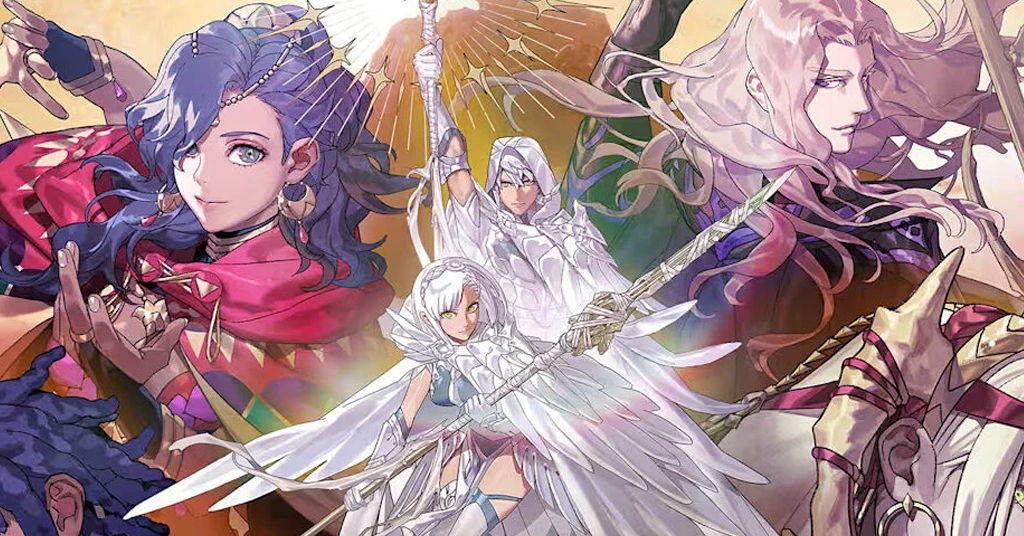
Fire Emblem: Fortune’s Weave is three weeks from release. Several major outlets got extended hands-on time — anywhere from 10 to 20-plus hours, covering the opening chapters across all four story paths — and the early consensus is that this might be the most ambitious Fire Emblem Intelligent Systems has ever built. Let’s get into what’s actually in it.
You start by creating a customisable protagonist who ends up at something called the Obelisk Chamber, where a goddess named Fortuna — speaking on behalf of Sothis, from Three Houses — sends you back through time to rewrite the histories of four fallen heroes, referred to as the Flame Lords. It’s a strange, sci-fi-tinged framing device — there’s talk of advanced computer systems and magic-firing guns bleeding into a fantasy setting — and more than one previewer admitted the opening hours throw a lot at you without fully explaining it. It’s clearly just the first few pieces being placed on a much bigger board.
Once you pick one of the four obelisks, you’re pulled into the past and steered toward Dagsion, the capital of the Dagdan Empire. This is where the Heroic Games take place — Fire Emblem’s spin on a gladiatorial tournament, hosted by the region’s ruling deity, where the eventual winner is granted a single wish. The four leads each have their own reasons for entering. Cai is a village boy trying to help his imprisoned father and finds himself pulled into something bigger than he expected. Leda is a travelling musician hunting the person responsible for her father’s death. Theodora is a queen trying to prove herself strong enough to lead her people. And Dietrich is a swordsman from Fódlan — Three Houses’ setting — whose path through the Games ties into some genuinely old, obscure history between the two regions. You can move between all four campaigns pretty freely rather than being locked into one.
Between story missions, you get free time, measured in turns, to spend however you like — and previewers are consistently describing this as far bigger and more varied than Three Houses ever was. You can train, recruit, bond with characters through voiced support conversations, run errands, trade with merchant companies that apparently have their own storylines, perform in plays, visit a spa, eat at a tavern, farm, and just generally poke around a capital city that by itself reportedly takes up more time than the battles do. It settles into a loose weekly rhythm—training or exploring, then a reset—and if you make choices you regret, you can restart the chapter from the beginning rather than live with it.
Sitting on top of all that is a proper overworld — large-scale, spanning the whole region, and one previewer compared movement across it to a tabletop game, where you cover a set number of spaces per turn and stumble into random encounters along the way, apparently inspired partly by medieval Spain. It’s a bigger structural addition than anything Three Houses had.
Dungeons return. Dungeon crawling is back for the first time since the Shadows of Valentia remake, but instead of reusing Fire Emblem’s grid-based tactics, these sections run as more traditional turn-based combat, closer to an old-school JRPG than a tactics game. The reception across the board is polite rather than enthusiastic: one outlet called it underwhelming and pointed to the built-in skip button as a sign the developers weren’t fully confident in the system, another said it hadn’t found a dungeon that felt properly challenging even on harder difficulties, and a third called it a decent pacing change without being especially deep.
Main story combat is still classic Fire Emblem — grid-based, rock-paper-scissors weapon interplay, the works — and that’s largely where the excitement is. Each hero has a personal ability called a Blaze Art: a character-specific move that costs HP to activate but can swing a fight in your favour. One previewer described using Theodora’s ability to hurl rocks across the map, ending encounters before they’d properly begun; another highlighted Leda’s version, which buffs nearby allies through a musical performance rather than dealing damage directly. Sitting alongside that is a separate system called Combat Arts, which power up a specific weapon at the cost of chipping away its durability. Both add a bit of risk-reward tension without changing the core flow of a battle. Enemy AI on harder difficulties is also getting called out as noticeably sharper, with more than one previewer noting it deliberately targets the weakest unit on the field.
Previewers don’t agree on how much the underlying combat system has actually changed. One account describes the classic weapon triangle being thrown out and replaced with new class-by-class rules — axes hitting harder but less accurately, swords rewarding follow-up attacks, lances getting a flat bonus against cavalry, and guns essentially functioning like fists. Another account, covering a different story path, described the core mechanics as largely unchanged from previous entries, with Blaze Arts doing the heavy lifting for anything new.
The animation and combat presentation are getting singled out as the best the series has looked, helped by this being Intelligent Systems’ first game built exclusively for Switch 2. The one specific complaint is that critical hits reportedly land a little flat compared to the more dramatic crit animations of older entries — a small nitpick rather than a real concern. There’s also a Mouse Mode control option for players who want more precise unit placement.
Overall sentiment is strongly positive, but not identically so. The most enthusiastic accounts are calling this possibly the best Fire Emblem yet — one previewer went as far as suggesting it might finally solve a problem that’s followed the series since Awakening, where individual entries tend to nail either the story or the combat but rarely both. Another called it the most ambitious game they’d played on Switch 2 so far, while flagging real uncertainty about whether a game this dense can stick the landing over a full runtime — noting that both Three Houses and Engage lost momentum in their back halves. The most reserved account, by contrast, admitted the opening hours hadn’t fully clicked for them yet, even while saying they wanted to keep playing regardless. This isn’t uniform hype; it’s a large, ambitious game that’s impressed nearly everyone to different degrees.
Fire Emblem: Fortune’s Weave releases on Nintendo Switch 2 on September 17th. Based on ten to twenty-plus hours of early access across four different outlets, it’s shaping up to be Intelligent Systems’ biggest attempt yet at building on the Three Houses formula — four fully separate campaigns, a proper world map, returning dungeons, and a new layer of risk-reward combat systems. Whether it holds together as one of the best entries in the series, or buckles under its own scale in the back half, is something nobody will know for certain until review copies land.
Leave a Reply