
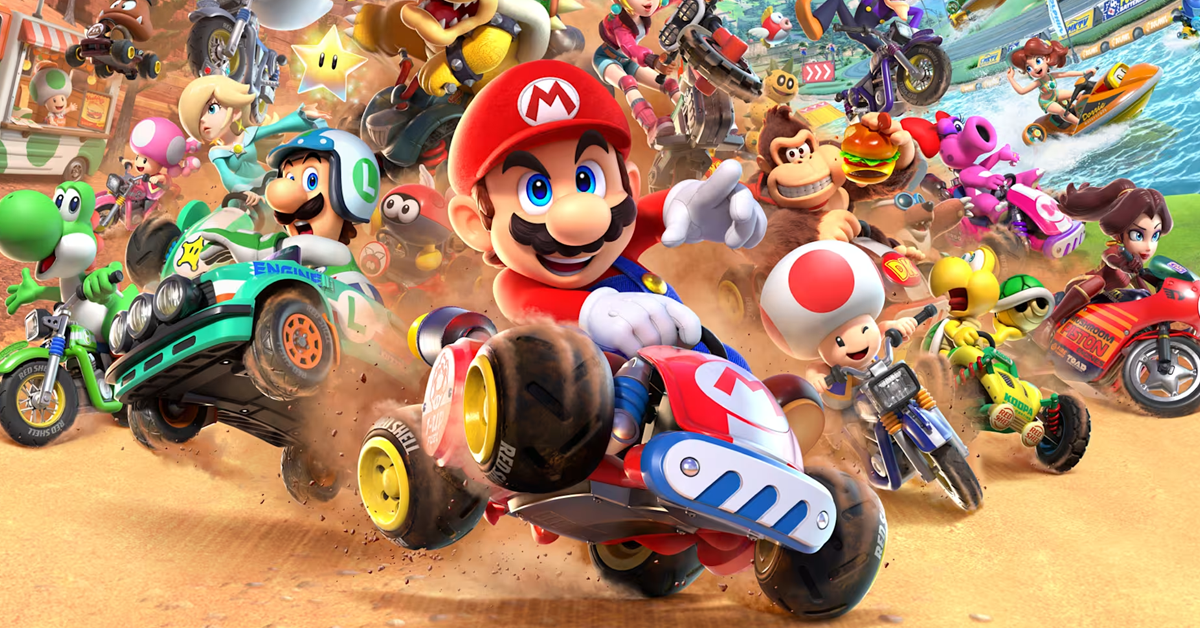
Mario Kart World is kicking off the next-generation of Nintendo consoles on the Switch 2, but how does this compare to other Nintendo launch titles of the past. Today I’m going to check out Mario Kart World, then do a tier list of Nintendo launch titles on past consoles to see where Mario Kart World compares.
Before we get into things, I’m going to be checking out first-party Nintendo games from Nintendo, and keeping it to a maximum of 3 per console.
Mario Kart World
Mario Kart World is the next iteration of Mario Kart launching with the Swicth 2. Departing from the traditional format, it introduces an open-world design, off-roading, boat racing, rail grinding, wall jumping, and a new elimination-style mode called “Knockout Tour.” The game supports up to 24 players—twice as many as previous entries—and features 50 playable characters, many with unlockable costumes. “Free Roam” mode allows players to explore the world freely, complete missions, and take photos, drawing comparisons to Forza Horizon. Classic tracks return, reimagined to fit the open-world format and dynamic environments.
That is a brief description of Mario Kart World, but how does it stack ip against other Nintendo launch titles? Let’s have a look at other launch titles from past Nintendo consoles, plus we’re going to build a tier list.
Nintendo Entertainment System (1986)
The Nintendo Entertainment System (NES) launched in North America in October 1985, initially in New York City as a test market, with a full national rollout in 1986. Following the video game crash of the early 1980s, Nintendo aimed to revive the industry by marketing the NES not just as a game console, but as an entertainment system. It included unique accessories like the Zapper light gun and R.O.B. the Robot to help differentiate it from previous failed consoles. Bundled with titles such as Super Mario Bros, Duck Hunt, the NES showcased Nintendo’s innovation and quality.
Super Mario Bros is one of the most influencial games ever made, and Duck Hunt was good fun, albeit mainly a tech demo for the light-gun Zapper.
Super Mario Bros – S tier
Duck Hunt – B tier
Gameboy (1990)
The Game Boy launched in North America in July 1989, following its debut in Japan in April of the same year, and quickly became a landmark success in handheld gaming. Developed by Nintendo and led by engineer Gunpei Yokoi, the system featured a monochrome screen, simple controls, and impressive battery life, which made it both affordable and portable. It launched alongside the game Tetris, a strategic move that broadened its appeal beyond traditional gamers and helped drive massive sales. Other early titles included Super Mario Land.
Super Mario Land was a good game for the time, but it didn’t feel like a Mario game. Tetris on the other hand was a fantastic game from the start, and remains so all these years later.
Super Mario Land – C tier
Tetris – S tier
Super Nintendo (1991)
The Super Nintendo Entertainment System (SNES) launched in North America in August 1991, following its 1990 debut in Japan as the Super Famicom. Building on the success of the NES, the SNES offered improved graphics, sound, and gameplay capabilities, bringing 16-bit gaming to a broader audience. At launch, it featured standout titles like Super Mario World, F-Zero, and Pilotwings, which demonstrated the system’s advanced technology and helped drive early adoption.
Super Mario World was a great step up in the world of Mario Bros, introducing Yoshi and also Mario’s flying ability. Pilot Wings was a new franchise, and something that never really captured my imagination. F-Zero was a quality racing game, introducing the world to Captain Falcon. I’m still a fan of F-Zero today, even though some fans prefer the later titles in the series.
Super Mario World – S tier
Pilot Wings – C tier
F-Zero – A tier
Nintendo 64 (1996)
The Nintendo 64 (N64) launched in North America on September 29, 1996, following its debut in Japan earlier that year. As Nintendo’s first 3D-focused console, it introduced groundbreaking graphics and gameplay, largely thanks to its flagship launch title, Super Mario 64, which revolutionized 3D platforming. The console also launched with Pilotwings 64, showcasing its technical capabilities.
Super Mario 64 helped define 3D gaming, and it’s still a fun game to go back to, although it does show it’s age, with the Nintendo 64s polygon graphics not aging as well as the Super Nintendo. Pilot Wings was a 3D iteration on Pilot Wings for the Super Nintendo, albeit in a 3D environment.
Super Mario 64 – S tier
Pilot Wings 64 – C tier
Gameboy Advance (2001)
The Game Boy Advance (GBA) launched in North America on June 11, 2001, after its initial release in Japan in March of the same year. As the successor to the Game Boy Color, the GBA featured a 32-bit processor, a wider screen, and significantly improved graphics and sound, bringing near-Super Nintendo quality gaming to a handheld device. The launch lineup included titles like Super Mario Advance, and F-Zero: Maximum Velocity.
Super Mario Advance is a port of Super Mario 2 from the NES. I loved Super Mario 2, so to be able to play it on a handheld at the time was incredible. F-Zero Maximum Velocity was the first handheld F-Zero game, so served the purpose of having console-like games in your hand, and was a huge step up from the original Gameboy.
Super Mario Advance – A tier
F-Zero Maximum Velocity – C tier
GameCube (2001)
The Nintendo GameCube launched in North America on November 18, 2001, following its release in Japan and coinciding with the sixth generation of consoles. Marking Nintendo’s shift to optical discs, the GameCube used mini-DVDs to improve storage while maintaining faster load times. The launch lineup featured key titles like Luigi’s Mansion, Wave Race: Blue Storm, and Star Wars Rogue Squadron II: Rogue Leader, though the absence of a mainline Mario game was notable.
Luigi’s Mansion was a decent game, although at the time Nintendo received a lot of questions about Mario. Where was the mainline Mario game, and was Luigi’s Mansion a suitable replacement? Over time people look back more fondly on Luigis Mansion compared to when it was released. Wave Race Blue Storm was OK, but I wasn’t really a fan of the Wave Race series.
Luigi’s Mansion – B tier
Wave Race Blue Storm – C tier
Nintendo DS (2004)
The Nintendo DS launched in North America on November 21, 2004, introducing a bold new handheld design with dual screens, including a touchscreen, a built-in microphone, and wireless connectivity—all innovative features at the time. Positioned as a “third pillar” alongside the Game Boy Advance and GameCube, the DS offered a new way to play games, blending traditional controls with new interaction methods. The launch lineup included titles like Super Mario 64 DS, Madden NFL 2005, and Metroid Prime Hunters: First Hunt (a demo), which showcased its capabilities.
Super Mario 64 remains one of the best games of all time, and for the Nintendo DS they added new graphics, characters, collectibles, a multiplayer mode, and several extra minigames. In a huge twist, Yoshi is the first playable character.
Metroid Prime Hunters: First Hunt was only a demo for the full game, which wouldn’t release until 2006. It’s the first Metroid game for the Nintendo DS. The game includes three short single-player games, a trailer for the full game, and a small multiplayer section.
Super Mario 64 DS – S tier
Metroid Prime Hunters – D tier
Wii (2006)
The Nintendo Wii launched in North America on November 19, 2006, and marked a major shift in gaming with its focus on motion controls and accessible gameplay. Bundled with Wii Sports, the console appealed to a broad audience, including non-traditional gamers, by offering intuitive, physical interaction through the Wii Remote. Key launch titles included The Legend of Zelda: Twilight Princess, Excite Truck, and Red Steel.
Wii Sports is legendary, it’s definitely a tech demo but who didn’t play Wii Bowling when getting together with the family around the holidays. This was the pack in game for the Wii, although not in Japan. Regie Fiis-Amie had to fight hard for this to be a pack in game, and looking back now he was right, this helped the Wii explode onto the marlket.
Twilight Princess was released on both GameCube and Wii, although the Wii version included motion controls. This is a pretty divisive Zelda game, you either love it or hate it. I love it, and it was great to have a Zelda title for launch.
Wii Sports – A tier
Twilight Princess – A tier
Nintendo 3DS (2011)
The Nintendo 3DS launched in North America on March 27, 2011, introducing glasses-free 3D visuals as its signature feature. It also included enhanced graphics, a built-in gyroscope, StreetPass and SpotPass connectivity, and backward compatibility with DS games. The launch lineup featured titles like Pilotwings Resort, Super Street Fighter IV: 3D Edition, and Nintendogs + Cats, though it lacked major first-party system sellers like Mario or Zelda. Despite strong initial interest, sales were slower than expected, prompting a significant price drop just months after launch.
Pilotwings Resort – D tier
Nintendogs + Cats – C tier
Wii U (2012)
The Wii U launched in North America on November 18, 2012, as Nintendo’s first HD console and the successor to the Wii. Its standout feature was the GamePad, a tablet-like controller with a built-in touchscreen that enabled new forms of gameplay, including off-TV play and second-screen experiences. The launch lineup included titles like New Super Mario Bros. U, Nintendo Land (bundled with some versions), and third-party games such as ZombiU and Assassin’s Creed III. Despite initial curiosity, the Wii U struggled with marketing confusion—many consumers mistook it for an add-on to the Wii—and suffered from a lack of consistent software support.
New Super Mario Bros U – B tier
Nintendo Land – C tier
Nintendo Switch (2017)
The Nintendo Switch launched on March 3, 2017, as a hybrid console that could seamlessly switch between handheld, tabletop, and TV modes, offering unprecedented flexibility in how games were played. Its innovative design, combined with the detachable Joy-Con controllers and local multiplayer features, set it apart from traditional consoles. The launch was headlined by the critically acclaimed The Legend of Zelda: Breath of the Wild, which helped drive strong early sales and enthusiasm. Other launch titles included 1-2-Switch and Snipperclips.
Breath of the Wild was an incredible launch game for the Switch. It perfectly demonstrated the hybrid nature of the console, where you could play it hooked up to your TV, then throw the console in your bag and play a AAA video game on the bus, plan or at a rooftop party (famously shown in the reveal video).
1-2 was just OK, a good demo of the HD rumble and the JoyCon capabilities, but nothing to write home about.
Breath of the Wild – S tier
1-2 Switch – D tier
Where does Mario Kart World fit?
Mario Kart World has the potential to be up there in the S tier and A tier of Nintendo first party launch games. It builds upon what was great with Mario Kart 8 Deluxe, and introduces the Knockout mode plus tje vast open-world. It’s very early in the lifecycle of the game, and the secrets haven’t all been discovered yet, but they will be soon. While I can’t place it until I put similar hours into Mario Kart World compared to other games, on first impressions I think Nintendo has a major hit on their hands.
Let me know where you think Mario Kart World will stack up against these other launch titles. It’s going to be tough, these are some of the bets games ever made, but I have faith, I think Mario Kart World is going to be awesome.
Leave a Reply