
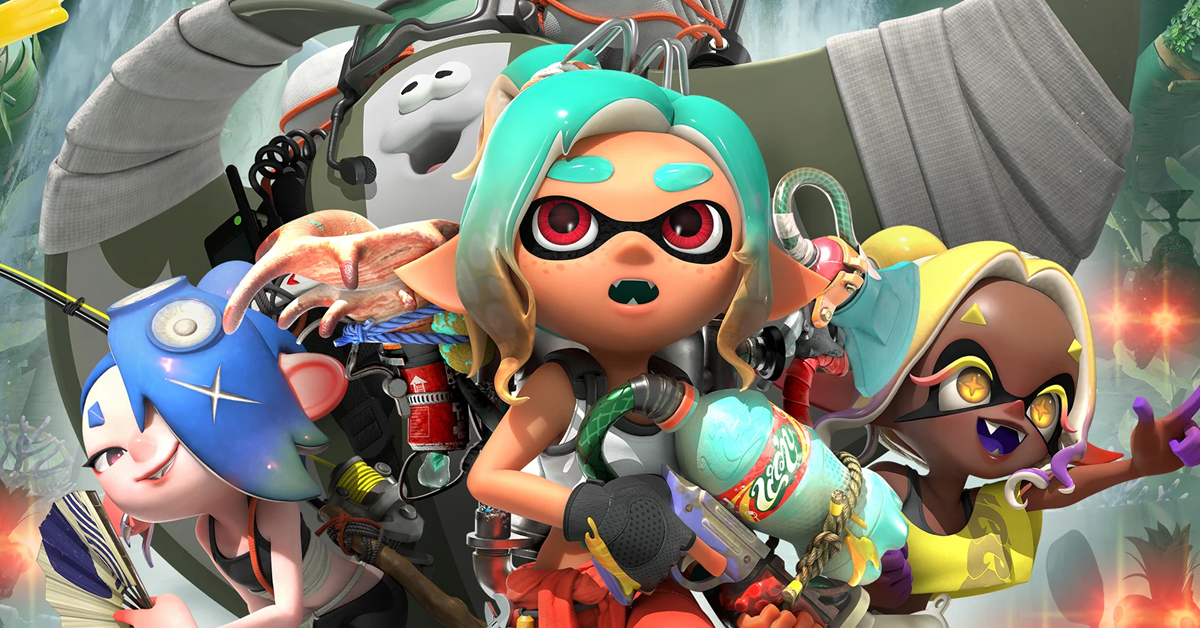
I wasn’t going to buy Splatoon Raiders.
I’ve never been a Splatoon person. Turf War never clicked for me; every time a new mainline entry dropped, I watched from a distance and moved on. So when Nintendo revealed this as a single-player spin-off instead of Splatoon 4, my reaction was closer to indifference than excitement.
I picked it up anyway. And I have not stopped playing it since.
This video is about two things: first, whether Splatoon Raiders is actually good. Second, whether Nintendo’s gamble on a non-competitive Splatoon spin-off is actually paying off commercially. Because those two things don’t always line up, and with this game, the story is more interesting than “it’s good, buy it.”
What Splatoon Raiders actually is
Quick context for anyone who, like me a few weeks ago, wasn’t paying close attention. Splatoon Raiders released July 23rd, exclusively on Switch 2, priced at $49.99 digital and $59.99 physical — a full ten dollars under what Nintendo usually charges for a first-party Switch 2 release. Nintendo positioned this as an experiment, not a numbered mainline entry.
You play as a mechanic who ends up on a chain of islands called the Spirhalite Islands, working out of a base called the Hideout Ship, accompanied by Deep Cut, the trio from Splatoon 3. From there, it’s raid after raid into Salmonid-controlled territory, hauling back loot, upgrading your gear, and building out a loadout. Up to four players can join in co-op, locally or online, with difficulty scaling to match.
Structurally, the raids themselves come in a few different flavours, which is part of why the loop doesn’t wear thin as fast as you’d expect. Some are straightforward linear runs that end in digging up treasure. Others are timed challenges where you’re racing to collect a set number of power eggs before the clock runs out. And there’s a difficulty system — Tourist, Raider, and Survivalist tiers — where, notably, the difficulty you choose doesn’t gate what loot you can get.
The whole thing is also built around gadgets — new traversal and combat tools that let you leap high into the air, pull off powerful charges, or throw out multiple devices at once. Between the gadgets and the vertical level design, it feels like Nintendo actually designed movement and combat from scratch around a single-player power fantasy, rather than just repurposing assets from the mainline games.
The obvious question going in was: why isn’t this Splatoon 4? Producer Seita Inoue and director Yoshihiko Ito explained in an official interview that after eleven years and three near-identical mainline entries, a fourth numbered game built on the same competitive foundation felt too iterative.
Instead, they wanted something that let the non-competitive side of Splatoon — Salmon Run, solo campaigns — stand on its own as an entry point, rather than staying a secondary mode bolted onto a multiplayer game. Inoue was clear that Splatoon 4 is still coming eventually. This was Nintendo deliberately building something different first.
Is it actually good?
The aggregate is strong. Sitting in the low-to-mid 80s on both Metacritic and OpenCritic, which puts it right in line with the mainline trilogy — Splatoon 3 landed an 83, and Raiders is tracking close behind that. IGN gave it a 9 out of 10, calling it an expertly executed action RPG loop with upgrades worth chasing and a difficulty curve that never tips into padding. Nintendo Life matched that with their own 9 out of 10.
But then you’ve got Giant Bomb at 3.5 out of 5, and The Guardian landing at just two stars, unimpressed by what they saw as a fairly ordinary game underneath the ink.
And I understand why, having played a chunk of it myself. If you’re coming at it the way I did, without any real attachment to the multiplayer scene, it’s just… a genuinely well-built loot-and-upgrade loop. Short raids, constant incremental progress, co-op that never feels tacked on. It’s Nintendo taking Salmon Run and building an entire game’s worth of structure around it, and for me, that structure is what makes it click.
Worth flagging too — early Metacritic user scores have been running notably high, to the point some outlets have called it one of the platform’s best-received launches by user rating. I’d treat any specific numerical claim there as a snapshot rather than gospel, since user score rankings shift by the day. The people actually playing it are, on balance, into it.
The pricing decision
$49.99 digital is ten dollars below what Nintendo has charged for its recent Switch 2 flagship releases. Nintendo has priced this explicitly as a spin-off, not a numbered mainline entry — the packaging around the game reinforces that too. There’s no deluxe edition, no collector’s edition, no season pass tier, which in 2026 is almost unusual enough to be a headline on its own.
Pricing strategy is doing real work here. It lowers the barrier for exactly the kind of player I was a few weeks ago — someone curious but not attached to the franchise, who might hesitate at full mainline price for a game they’re not sure they’ll like.
Is it selling?
In Japan, Splatoon Raiders debuted at number one on the physical charts for the week ending July 26th, moving 474k physical copies in its opening weekend alone — and that’s before eShop digital sales are even factored in, since Japan’s Famitsu chart only tracks physical retail. For context on how stacked that chart was: Mario Kart World crossed 3 million lifetime physical copies in Japan that same week, and Tomodachi Life passed 1.5 million. Raiders still topped both of them in a single debut weekend.
In the UK, the story’s just as strong, and arguably more impressive given the competition. Raiders debuted at number one on its release week, ahead of established chart regulars. As of the chart for the week ending August 1st, it’s only slipped a single spot to number two — and only because Halo: Campaign Evolved launched into the top spot that same week.
Holding at number two against a fresh Xbox flagship launch, in week two, is a strong result for a spin-off.
Where does this leave the franchise?
Splatoon Raiders succeeds specifically because it doesn’t try to be Splatoon 4. It’s not chasing the competitive audience. It’s Nintendo testing whether Splatoon’s cooperative, non-competitive DNA can carry a full game on its own — and based on the sales charts and the review spread trending positive, the answer looks like yes.
For me personally? I went in expecting to bounce off it in an hour, and instead I’m dozens of raids deep, still chasing upgrades. What’s kept me coming back isn’t nostalgia for the series or any attachment to the ink-splatting fantasy — it’s the pure mechanical loop. Finish a raid, see what dropped, tweak the build, go again. It’s the same hook that’s made looter-shooters a genre unto themselves for years, except Nintendo has wrapped it in Splatoon’s art direction and character work, which might be the smartest part of the whole package. You’re not just chasing stat upgrades in a vacuum; you’re doing it while Deep Cut banters at you from the Hideout Ship, which gives the grind a personality most games in this genre don’t bother with.
If you’re on the fence the way I was — not a Splatoon person, lukewarm on the single-player spin-off concept, maybe burned by past attempts at bolting a story mode onto a multiplayer game — I’d say this is the one that might actually get you. It’s asking you to enjoy a tight, well-paced upgrade loop, and it delivers that without much friction at all.
Splatoon 4 is still coming, by Nintendo’s own admission. But Splatoon Raiders has made a genuinely strong case that it shouldn’t just be treated as a placeholder before the “real” next game. It’s carved out its own space, and the numbers say players are showing up for it.
That’s where I’ll leave it. If you’ve played Raiders, I want to know if you bounced off it or got hooked the way I did — drop it in the comments.
Leave a Reply